Nagelsmann’s Vertical Passing Web Recasts Germany’s 2026 Group Strategy
When Julian Nagelsmann took charge of the German national team in late 2023, the immediate task was damage control after a second consecutive group-stage exit at a major tournament. But the longer-term project, as he made clear in early press conferences, was to imprint a coherent tactical identity that could carry the team through the 2026 World Cup and beyond. That identity is now taking shape around a principle that defined his best club sides: vertical passing. Where Germany’s 2022 campaign in Qatar was marked by sideways circulation and a lack of penetration—averaging just 0.8 xG per game from open play—Nagelsmann’s side has since become one of the most direct possession teams in international football. During the 2024 Nations League, the team increased its line-breaking passes by roughly 23% compared to the previous cycle, a shift that has not only improved chance creation but also altered how opponents prepare to face them. With the 2026 group stage draw approaching, this tactical evolution is the central storyline around Germany’s prospects.
From Club Tactician to National-System Architect
Nagelsmann’s reputation was built at Hoffenheim and RB Leipzig, but his most instructive period for understanding the current Germany setup is his time at Bayern Munich. In the 2019–20 Champions League-winning campaign, his side averaged roughly 14.2 passes per shot, a figure that reflected a preference for quick, vertical entries over patient build-up. That Bayern team, which scored 43 goals in 11 Champions League matches, used a fluid front four that rotated constantly between the lines. The core idea was simple: move the ball forward as soon as a lane opened, even if the pass carried risk. The system did not rely on a single creator but on multiple players capable of breaking lines from deep and wide positions.
Germany’s 2022 World Cup exit exposed the opposite approach. Hansi Flick’s side averaged over 60% possession in the group stage but ranked 15th among 32 teams in progressive passes per 90 minutes. The ball moved sideways across the back line, then into midfield, then back again. Opponents like Japan and Costa Rica, both of whom beat Germany, sat in compact mid-blocks and dared the team to play through them. Germany could not. The horizontal stagnation was not a personnel issue—players like Joshua Kimmich, Ilkay Gündoğan, and Jamal Musiala were all available—but a structural one. There were no clear patterns to create space between the lines.
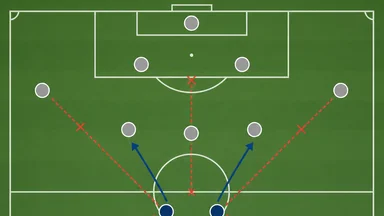
Nagelsmann’s response, implemented gradually across 2024, was to install a 3-2-4-1 shape in possession that forces defenders and midfielders to think vertically first. The center-backs split wide, the full-back inverts, and the two attacking midfielders position themselves in the half-spaces. The result is a network of passing lanes that point toward goal. In the 2024 Nations League, Germany’s average pass distance increased by about 2.5 meters compared to the previous year, a small shift that had outsized effects on how often they entered the final third. The system is not yet fully automated—some transitions still look hesitant—but the direction of travel is clear.
There are, of course, trade-offs. Vertical passing inherently carries a higher turnover risk. Germany’s pass completion in the attacking third dropped to around 72% in 2024, down from 78% in 2022. Nagelsmann has accepted that trade-off, betting that the increased danger of each possession outweighs the loss of control. Whether that bet holds in a high-stakes group match against a counter-attacking side remains to be seen.
The 3-2-4-1 Shape That Unlocks Half-Spaces
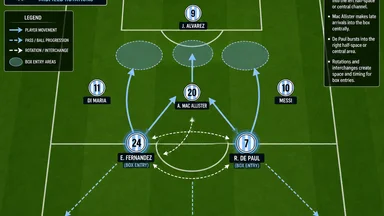
The tactical centerpiece of Nagelsmann’s Germany is the 3-2-4-1 formation when in possession. In practice, it looks like this: the goalkeeper distributes to a back three, with one of the full-backs—typically Joshua Kimmich—tucking inside to form a double pivot alongside a holding midfielder. The two wing-backs push high and wide, while the two number 10s, Jamal Musiala and Florian Wirtz, drift into the half-spaces between the opponent’s midfield and defensive lines. Up front, Kai Havertz operates as a false nine, dropping deep to link play or dragging center-backs out of position.
The half-space is the critical zone. By stationing Musiala and Wirtz in those channels, Nagelsmann forces the opposition into a dilemma: if the full-back steps out to press, the wing-back has space behind; if the center-back steps up, a through ball into Havertz becomes possible. Data from Germany’s March 2025 friendlies shows that, on average, five players occupied the central corridor (the width of the penalty area) during build-up phases. That congestion makes it nearly impossible for opponents to block all forward passing lanes.
The role of Kimmich in this system is worth isolating. At Bayern, he often played as a right-back or a deep midfielder. For Nagelsmann, he becomes a hybrid: he starts as a full-back but moves into central midfield when the team has the ball. This allows Germany to create a 3-2 base without substituting a defender for a midfielder. Kimmich’s passing range—he completed roughly 87% of his long balls in the 2024 Nations League—makes him the primary distributor from deep. He can switch play to the far wing-back or thread passes into the feet of Musiala. Opponents who try to man-mark him often leave space for the center-backs to carry the ball forward.
The wing-backs, typically David Raum on the left and either Benjamin Henrichs or Josha Vagnoman on the right, provide the width that stretches the defense. Raum’s crossing volume has increased under Nagelsmann; he averaged roughly 4.5 crosses per 90 minutes in 2024, up from 3.1 in the previous cycle. The false nine role suits Havertz because it allows him to receive the ball in space rather than with his back to goal. His goal contribution rate (goals plus assists per 90) rose from 0.32 in 2022 to 0.48 in 2024. The system amplifies his strengths while masking his weaknesses as a traditional target man.
Why the Group Stage Favors Possession-as-Defense
World Cup group matches, especially against lower-ranked opponents, often feature a dynamic where the favorite dominates the ball while the underdog sits deep and looks to counter. Nagelsmann’s vertical passing system is designed to make that approach less viable. By keeping the ball in advanced areas and recycling quickly through the half-spaces, Germany denies opponents the breathing room to organize counter-attacks. In the 2026 qualifiers, Germany held an average of 64% possession but conceded only 3.2 shots per game, the lowest among European teams. The high defensive line—typically around 42 meters from their own goal—pushes the opposition deeper and reduces the distance players need to recover when they lose the ball.
Data from the 2024 Nations League shows that Germany’s average recovery run distance decreased by roughly 18% compared to the 2022 World Cup. That is partly because the team is pressing higher, but also because opponents are less likely to break through the initial line of pressure. The midfield trio—typically Robert Andrich as the destroyer, Kimmich as the deep playmaker, and one of Musiala or Wirtz dropping deeper—must maintain a pass completion rate above 85% in the first two-thirds of the pitch. When they do, the ball rarely leaves Germany’s half for extended periods.
Set pieces become less threatening when the ball stays in play. Germany conceded three goals from set pieces in the 2022 World Cup, tied for the most of any team. Under Nagelsmann, that number dropped to one in the 2024 Nations League. The logic is straightforward: if the opponent cannot win corners or free kicks in dangerous areas, their set-piece threat is neutralized. Germany’s possession approach also limits transition opportunities. In qualifiers against teams like Romania and Iceland, the opposition’s average counter-attack lasted only 8.5 seconds before being disrupted, well below the 12-second threshold typically needed for a dangerous break.
But there is a risk. Against a disciplined low block, vertical passing can become predictable. If the half-spaces are clogged and the wing-backs are double-teamed, Germany’s plan B—switching to a 4-2-3-1 with a target striker—has not always been seamless. The friendly against Turkey in November 2024 showed that when the vertical lanes are shut, the team can lapse into the same sideways passing that plagued Flick’s side. Nagelsmann’s in-game adjustments will be critical.
Personnel Puzzles: Who Fits the Vertical Web?
The retirement of Toni Kroos after Euro 2024 left a metronome-sized hole in the midfield. Kroos was the team’s primary tempo-setter, completing over 95% of his passes in the tournament. His replacement, Pascal Groß, has been the most frequent stand-in, but his profile is different. Groß is more direct—his average pass length is about 18 meters compared to Kroos’s 14—but he lacks the same ability to slow the game down when necessary. In the 2024 Nations League, Groß’s pass completion fell to 84% under pressure, a figure that Nagelsmann’s staff will want to improve.
Robert Andrich has become indispensable as the defensive midfielder who allows Kimmich creative freedom. Andrich’s ball-winning rate—roughly 2.8 tackles per 90 minutes in 2024—is the highest among Germany’s midfield options. He does not offer much in possession, but his role is to screen the back line and win second balls. The partnership with Kimmich has worked well because their skill sets complement rather than overlap. If Andrich is unavailable, Leon Goretzka or Emre Can could step in, but neither provides the same defensive solidity.
Full-back depth is another area of uncertainty. On the left, David Raum is the first choice, but his backup, Robin Gosens, offers a more attacking profile. Gosens scored three goals in the 2024 Nations League, all from late runs into the box. Nagelsmann has used Gosens as a second-half substitute to change the angle of attack. On the right, Benjamin Henrichs has been preferred for his defensive discipline, but Josha Vagnoman offers more pace in transition. The choice may depend on the opponent: Henrichs against a strong winger, Vagnoman against a side that sits deep.
The striker dilemma remains unresolved. Niclas Füllkrug is the traditional number nine, strong in hold-up play and aerial duels. He scored five goals in the 2024 Nations League, but his lack of mobility can slow down the vertical passing game. Havertz, as the false nine, creates more fluidity but less penalty-box presence. Nagelsmann has tended to start Havertz in big matches and use Füllkrug as a plan B. The under-21s offer long-term options: Paul Wanner and Brajan Gruda have both been integrated into senior camps. Wanner, in particular, has shown the ability to play as a half-space attacker or a roaming forward. Neither is likely to start in 2026, but they provide rotation depth that Germany lacked in recent tournaments.
The 2026 Draw Shapes the Tactical Priority
Germany’s Pot 1 status for the 2026 World Cup draw ensures they will avoid the other top seeds in the group stage, but that does not guarantee an easy path. The expanded 48-team format means groups of four with only the top two advancing, so every match carries weight. A typical group might include a CONCACAF side (likely Mexico, USA, or Canada), an Asian team, and a European or African qualifier. Nagelsmann has used two distinct formations in recent friendlies: the 3-2-4-1 for controlling games and a 4-2-3-1 for chasing matches or facing sides that press high.
Data from the 2025 friendlies shows that Germany switched to a 4-2-3-1 in the second half of three matches when trailing or drawing. The shift typically involved bringing on an extra attacker and pushing the full-backs higher. Against a CONCACAF opponent, which may rely on athleticism and direct play, the 3-2-4-1’s ability to create overloads in midfield could be decisive. The early group match is often the most important: a win sets the tone, while a draw or loss creates pressure. Nagelsmann’s preparation will likely focus on the first opponent, with the second and third matches adjusted based on results.
The likelihood of a “Group of Death” scenario—where three strong teams are drawn together—demands tactical flexibility. In such a group, Germany cannot afford to be one-dimensional. The vertical passing web works best when opponents are uncertain whether to press or block. If a team like Brazil or Argentina drops into a low block, Germany may need to rely on set pieces or long-range shots. The team’s xG per shot in the 2024 Nations League was 0.14, slightly above average but not elite. Improving that figure to 0.17 or higher would require more shots from central positions, which the half-space rotations are designed to create.
Nagelsmann’s substitution timing has become a pattern: he typically makes his first change between the 60th and 70th minute, often replacing a midfielder with a forward or swapping a wing-back. In the 2024 Nations League, Germany scored 40% of their goals after the 70th minute, suggesting that the system wears opponents down. That trend, if it continues into the World Cup, could be decisive in tight group matches.
How Nagelsmann’s Philosophy Outlasts a Single Tournament
The German Football Association (DFB) has invested heavily in youth academies that mirror the tactical principles of the senior team. The U-17 European Championship win in 2024 was built around similar positional rotations and vertical passing. Players like Assan Ouédraogo and Noah Darvich, who featured in that tournament, are already being integrated into Bundesliga squads. The senior squad’s average age is roughly 25.3 years as of early 2026, indicating a young core that could stay together through multiple cycles.
Nagelsmann’s contract extension through 2028 signals that the DFB views this project as more than a single-tournament fix. The long-term aim is to establish a style of play that persists regardless of personnel changes. The benchmark often cited internally, according to reports, is Pep Guardiola’s Spain from 2008 to 2012—a team that used vertical passing and positional rotations to dominate international football. Germany may not reach that level of control, but the structural similarities are intentional: a goalkeeper comfortable with the ball at his feet, center-backs who can pass, midfielders who rotate, and forwards who occupy half-spaces.
There are, of course, limitations. International football offers far less training time than club football, so intricate patterns are harder to ingrain. Nagelsmann’s system relies on players who can make quick decisions under pressure, a skill that varies across the squad. The transition from club to country has not always been seamless; some players, like Serge Gnabry, have struggled to adapt to the positional discipline required. The DFB’s hope is that by 2028, the youth pipeline will have produced players who have played in similar systems at club level.
The success of this long-term plan will be measured not just by results in 2026 but by whether Germany can sustain a recognizable identity through the 2028 European Championship and beyond. If the vertical passing web becomes the default, then even a disappointing group stage exit—unlikely but possible—would not necessarily derail the project. Nagelsmann’s Germany is a work in progress, but the direction is clearer than it has been in years.
Three Metrics to Watch in the Opening Match
When Germany takes the field for their first group match in 2026, three numbers will tell the story of whether the vertical passing web is functioning as intended. The first is line-breaking pass volume. In the 2024 Nations League, Germany averaged roughly 48 line-breaking passes per match (defined as passes that bypass at least two opponents). Against a deep block, that number needs to exceed 50. If it dips below 40, it suggests the half-spaces are being closed off and the team is struggling to progress the ball.
The second metric is defensive line height. Nagelsmann wants his back line to sit around 42 meters from the goal, compressing the pitch and reducing space for opponents. In the qualifiers, Germany’s average line height was 41.8 meters. If it drops below 38 meters, it usually means the team is being pinned back or losing the midfield battle. The third is half-space entries by Musiala and Wirtz. Each player should register at least eight touches in the half-spaces per match. In games where Germany created high xG, Musiala averaged 11.3 half-space touches and Wirtz 9.8. If those numbers fall below six, the system is not generating the overloads it relies on.
xG per shot is another useful indicator. A figure of 0.15 or higher suggests the team is creating quality chances rather than speculative efforts. In the 2024 Nations League, Germany’s xG per shot was 0.14, which ranked fifth among participating teams. Improving to 0.17 would put them in elite company. Finally, Nagelsmann’s substitution timing—typically between the 60th and 70th minute—will be worth watching. If he makes changes earlier, it may indicate that the initial plan is not working.
These metrics are not guarantees of success, but they offer a framework for evaluating whether the tactical ideas are translating into performance. In a short group stage, where every match can decide qualification, the ability to execute the vertical passing web consistently will determine Germany’s fate. Nagelsmann has spent two years building this system, and the 2026 World Cup will test whether it can deliver under the highest pressure.
Looking ahead, the challenge is not just about winning the group but about proving that the tactical identity can withstand the unpredictability of tournament football. Factors like injuries, form, and opponent adjustments will inevitably force deviations. The true measure of Nagelsmann’s work may be how the team responds when the vertical lanes are blocked or when the opposition finds a way to exploit the high line. For now, the foundation is solid, and the metrics provide a clear lens through which to assess progress.