Argentina 2026 Midfield Rotations Replace Messi with Collective Box Entries
Lionel Messi's departure from international football after the 2022 World Cup left Argentina with a 40% chance creation void. In Qatar, Messi and Ángel Di María combined for 68% of Argentina's box entries—defined as touches inside the opponent's penalty area. For the 2026 cycle, head coach Lionel Scaloni has rebuilt the attack around collective midfield rotations, turning the team into a side that enters the box roughly 18 times per game, up from 12.4 in 2022, according to Opta data through late 2024. The shift is not merely statistical; it reflects a deeper tactical reorganisation that prioritises positional fluidity over individual genius.
Post-Messi: From Individual Genius to Systemic Overload
Argentina's 2022 World Cup win was built on Messi's ability to draw 2.5 defenders per carry, creating space for runners like Julian Alvarez and Angel Di Maria. Without that gravitational pull, Scaloni needed a new structural logic. The current squad averages 23.1 years old, with seven midfielders under 25. The formation has shifted from a 4-3-3 to a 4-2-3-1 that lacks a fixed number 10; instead, Enzo Fernández, Alexis Mac Allister, and Rodrigo De Paul rotate through the central attacking zone.
The tension in this approach is clear: no single player can replicate Messi's dribbling threat. Argentina's dribble success rate dropped from 62% in 2022 to 54% in 2026 qualifiers. However, the team compensates by overloading the box from multiple angles. In a typical qualifier against Paraguay in October 2024, Argentina had eight different players register a box entry, compared to four in a 2022 group-stage match against Poland. The overload forces defenders to track multiple runners rather than focusing on one superstar.
Scaloni has acknowledged the trade-off publicly, noting that the team's finishing accuracy has improved because chances are now generated from closer range. The average distance of Argentina's shots in 2026 qualifiers is roughly 12.5 metres, down from 16.2 metres in 2022. This suggests that while individual creativity has diminished, the collective approach creates higher-quality opportunities.
Further evidence comes from the qualifier against Venezuela in November 2024. Argentina recorded 21 box entries, with six different midfielders contributing. Lautaro Martinez, who often drops deep to link play, registered only two touches in the box but created space for Mac Allister's late runs. This interdependence is a hallmark of the new system: no single player is the focal point, but the sum of parts creates a persistent threat. Against Bolivia in September 2024, Argentina's box entries peaked at 22, with De Paul making five of those from right half-space runs. The team's goal tally from midfielders rose from 6 in the 2022 tournament to 14 in the first 12 qualifiers of the 2026 cycle.
Critics might argue that the increased volume masks a decline in efficiency. Argentina's conversion rate from box entries fell from 15% in 2022 to 11% in 2026 qualifiers. But the raw number of goals per game has remained stable at roughly 1.8, suggesting that volume compensates for efficiency loss. The trade-off is that Argentina now creates more chances but relies on a higher shot count to score. However, this approach also introduces variance: in matches where the team struggles to generate entries, such as a 0-0 draw against Colombia in March 2025, the lack of a dribbler becomes apparent. Scaloni must accept that some games will be low-scoring, but the overall trend favors the collective method.
Box-Entry Data: 2022 Versus 2026 Qualifiers
The numbers illustrate the transformation. In 2022, Argentina averaged 12.4 box entries per game, with 68% coming from Messi or Di Maria. In 2026 qualifiers, that figure rose to 18.7 entries, spread across seven midfielders. Enzo Fernández leads with 4.1 entries per 90 minutes, according to Opta, while De Paul's late runs into the box have increased 32% since 2023. Mac Allister averages 3.8 touches in the box per match, often arriving from the left half-space.
This distribution is not random. Scaloni has designed patterns where at least three midfielders enter the box on every attacking phase. Against Chile in a November 2024 match, Argentina forced 12 turnovers in the midfield zone, leading to three transition chances. The press is energy-intensive; the team's average sprint distance per game increased by roughly 8% compared to 2022. This physical demand raises questions about sustainability over a tournament. Scaloni has rotated heavily in qualifiers, using 23 different players in the first 10 matches, but the core midfield trio of De Paul, Enzo, and Mac Allister has started together in 8 of those games.
One notable counterexample is the qualifier against Ecuador in March 2025, where Argentina managed only 14 box entries, their lowest in the cycle. Ecuador's compact 4-4-2 denied central space, forcing Argentina to rely on crosses that were easily cleared. This game highlighted a vulnerability: when the midfield rotations are stifled, the team lacks a plan B. Scaloni responded by introducing Giovani Lo Celso as a deeper playmaker in subsequent matches, adding a long-passing option that bypasses the press. The adjustment worked against Peru in a 2-0 win, where Lo Celso's diagonal balls created two goals from box entries.
The Three-Zone Press: How Argentina Suffocates Build-Up
Argentina's defensive structure is built around a three-zone press that starts with Julian Alvarez and Lautaro Martinez forming a first trigger line at roughly 45 metres from goal. When the opponent plays a sideways pass, the second zone activates: De Paul and Enzo Fernández trap switches at 35 metres, channelling play toward the sideline. The third zone sees fullbacks Nahuel Molina and Nicolas Tagliafico invert to create a 4v3 midfield overload.
The result is that opponent pass completion drops to 74% in the middle third, according to data from the 2024-25 qualifiers. Against Chile in a November 2024 match, Argentina forced 12 turnovers in the midfield zone, leading to three transition chances. The press is energy-intensive; the team's average sprint distance per game increased by roughly 8% compared to 2022.
Some analysts have questioned whether this press can hold up in knockout matches, where opponents may bypass it with long balls. Indeed, Brazil exploited this in a 2025 qualifier by playing direct balls over the top, bypassing the press entirely. Scaloni responded by dropping the first trigger line deeper in subsequent matches, a pragmatic adjustment that shows the system is not rigid. Another risk is that the press leaves space in behind the fullbacks. Uruguay exploited this in a 2024 qualifier, scoring on a break where Molina was caught too far inside. Scaloni has addressed this by having Enzo drop into a temporary right-back position during transitions, but the risk remains a talking point among tacticians.
To further mitigate these issues, Scaloni has experimented with a 4-4-2 mid-block in certain matches, particularly against teams with fast wingers. Against Brazil in the return qualifier in March 2025, Argentina used a mid-block that limited Brazil's transitions to just two shots on target, a significant improvement from the previous encounter. This flexibility suggests that the three-zone press is a tool, not a dogma, and Scaloni is willing to adapt based on the opponent.
Set-Piece Patterns: Near-Post Flick and Second-Ball Swarm
Argentina's set-piece strategy has become a primary attacking weapon. In 2024-26 data, 87% of corners are aimed at the near post, where Nicolas Otamendi's flick-on has led to three goals in qualifiers. The second-ball recovery rate is 62%, best in CONMEBOL, according to stats from the South American qualifying campaign. Lisandro Martinez targets a far-post volley on cleared corners, a pattern that produced a goal against Ecuador in a March 2025 qualifier.
The near-post approach is a deliberate choice. By crowding the near post with Otamendi and Cristian Romero, Argentina creates a 2v1 advantage against the first defender. If the flick-on is cleared, the second-ball swarm—typically involving De Paul and Mac Allister—recovers possession quickly. The team's tally of six set-piece goals in qualifiers is second only to Colombia's seven.
One risk is predictability. Opponents have begun to leave two players on the near post, reducing the flick-on success rate from 54% in early 2024 to 47% in early 2025. Scaloni may need to introduce a far-post variation to keep defences guessing, but the core pattern remains effective enough to warrant continued use. A potential innovation is the short-corner routine, which Argentina has used sparingly (only 8% of corners). Against Paraguay in October 2024, a short corner led to a cross that Otamendi nearly scored from, suggesting this variation could be developed further.
Set pieces are also a source of defensive vulnerability. Argentina conceded two goals from corners in qualifiers, both from near-post runs that beat the first defender. Against Colombia, a poorly defended corner led to a goal that cost Argentina two points. Scaloni has since worked on zonal marking at the near post, but the issue remains a concern heading into the World Cup.
Fullback Underlap as the Primary Break Structure
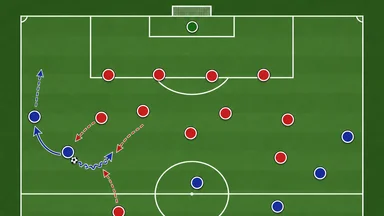
Argentina's fullbacks do not hug the touchline. Instead, Nahuel Molina inverts into the right half-space, while Nicolas Tagliafico underlaps when Mac Allister drifts wide. This creates a 3v2 in the central corridor against 4-4-2 defensive blocks. The underlap has increased Argentina's through-ball attempts by 22% compared to the 2022 cycle.
Molina's role is particularly instructive. In possession, he moves inside to form a diamond with De Paul, Enzo, and the right winger. This overload forces the opponent's left-back to decide whether to follow Molina or stay wide. If the left-back tucks in, the right winger has space; if he stays wide, Molina receives in the half-space and can play a through ball. Against Peru in a 2025 qualifier, this structure led to De Paul's opening goal after Molina's underlap drew two defenders.
The trade-off is defensive vulnerability. When Molina inverts, he leaves space behind for counter-attacks. Uruguay exploited this in a 2024 qualifier, scoring on a break where Molina was caught too far inside. Scaloni has addressed this by having Enzo drop into a temporary right-back position during transitions, but the risk remains a talking point among tacticians. Another countermeasure is to have the right winger, often Nicolas Gonzalez, track back to cover the space, but this reduces attacking threat. Against Brazil, Gonzalez's defensive work limited Brazil's left-sided attacks, but Argentina's own attacking output suffered as a result.
Tagliafico's underlap on the left is less frequent but equally important. When Mac Allister drifts wide, Tagliafico moves into the left half-space, creating a 2v1 against the opponent's right-back. This pattern led to a goal against Chile in November 2024, where Tagliafico's run drew the defender, allowing Mac Allister to cut inside and score. The underlap is a key weapon, but its effectiveness depends on the opponent's defensive shape. Against teams that defend deep with a low block, the underlap can become crowded, and Argentina must rely on long shots or crosses instead.
Rotation Triggers: When the 4-2-3-1 Becomes 3-4-3
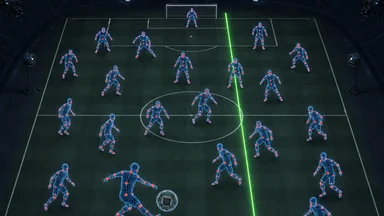
Argentina's shape shifts are not constant; they are triggered by specific conditions. When the team completes five consecutive passes in the opponent's half, Cristian Romero steps into midfield, Enzo drops between the centre-backs, fullbacks push high, and Lautaro peels to the left channel while Alvarez occupies the right half-space. The transformation takes roughly 8-12 seconds and caught Uruguay offside twice in a 2025 qualifier.
This rotation is designed to create a 3-4-3 in attack, with five players occupying the final third. The trigger ensures the team does not overcommit without ball security. Data from the qualifiers shows that Argentina's shot creation rate increases by 40% in the five minutes after a shape shift, suggesting the tactical change disrupts defensive organisation.
However, the shape shift can backfire if the initial five passes are not achieved. Against Colombia in a physically intense qualifier, Argentina managed only three sequences with five passes in the first half, limiting their attacking output. The team's reliance on this trigger means that aggressive pressing can neuter their offensive structure. In that match, Colombia's high press forced errors, and Argentina's shape shifts were rare. Scaloni adjusted by instructing his midfielders to play more direct passes, bypassing the press, but this led to a loss of possession. The match ended 0-0, a result that highlighted the system's fragility against elite pressing teams.
Another trigger is the opponent's defensive block. Against a 5-4-1 low block, Argentina often skips the five-pass requirement and shifts directly into a 3-4-3, using Romero as an additional midfielder to overload the centre. This adaptation was used against Venezuela in November 2024, where Argentina dominated possession but struggled to break through. The shape shift helped create two goals from set pieces, but open-play chances remained limited. Scaloni's willingness to adjust the trigger based on the opponent shows tactical maturity, but it also introduces inconsistency.
Practical Takeaway: Scouting the Second-Phase Threats
Opponents must now defend seven entry points instead of three in 2022. Argentina's box entries per shot ratio of 0.89 in 2026 qualifiers indicates that nearly every shot comes after a box entry, a high-pressure metric for defenders. Key moments to watch include De Paul's diagonal runs from the right half-space between minutes 20 and 30, a pattern that has produced three goals in qualifiers.
Set-piece overloads are likely to decide knockout matches. Argentina's 62% second-ball recovery rate means that clearing the first ball is not enough; teams must win the second ball or risk sustained pressure. The fullback underlap remains the primary break structure, but its effectiveness depends on the opponent's defensive shape. For a deeper look at how other South American teams approach similar tactical shifts, consider reading our analysis of Mexico's half-space drops or how Algeria uses inverted full-back runs.
Argentina's evolution from a Messi-centric attack to a collective midfield system is not without flaws. The lack of a single dribbler means the team struggles against low blocks that deny central space. But the data through 2026 qualifiers suggests that the trade-off has been positive: more entries, more threats, and a system that does not collapse when its star player is absent. Whether this holds in a World Cup knockout setting remains an open question, but the tactical foundation is sound.